Appearance
Use Cases
Reporting and analysis are important for managing a business and recognizing developments early. Naturally, an organization’s information needs depend on its line of business and can vary widely. A continuous-flow manufacturer with many products and customers has different requirements than a job-order manufacturer only a handful of customers.
With its modular approach, Taurec is an ideal tool for building tailored solutions, and the examples below illustrate typical applications.

 Management
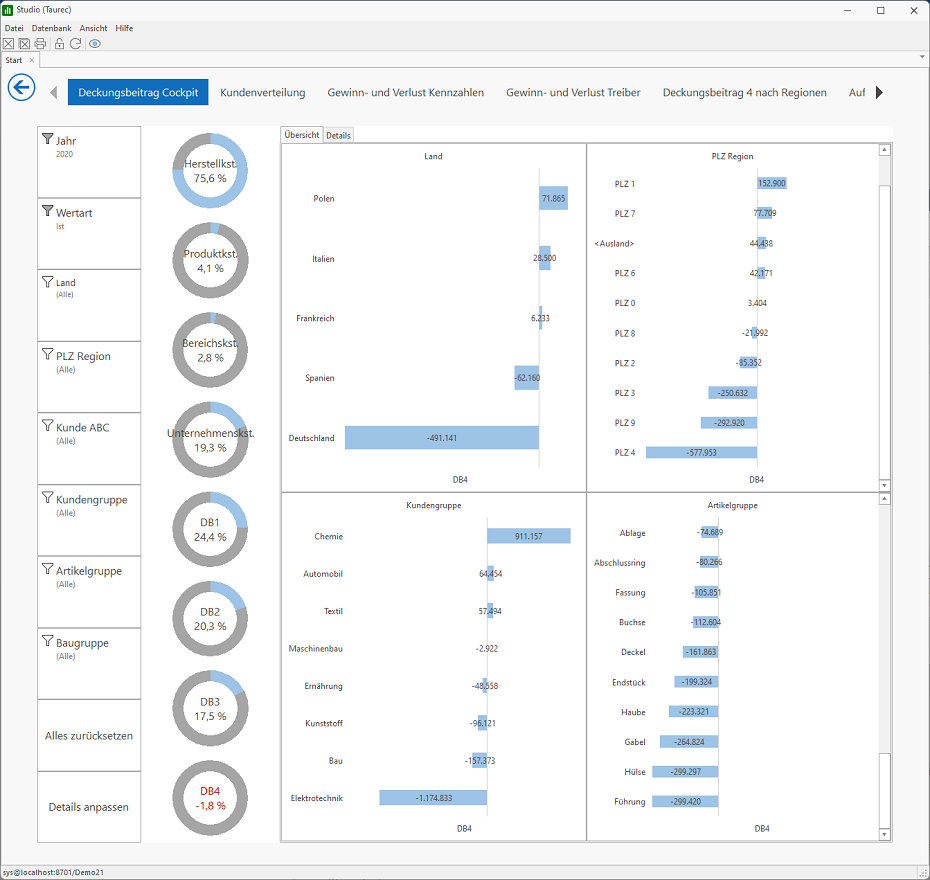
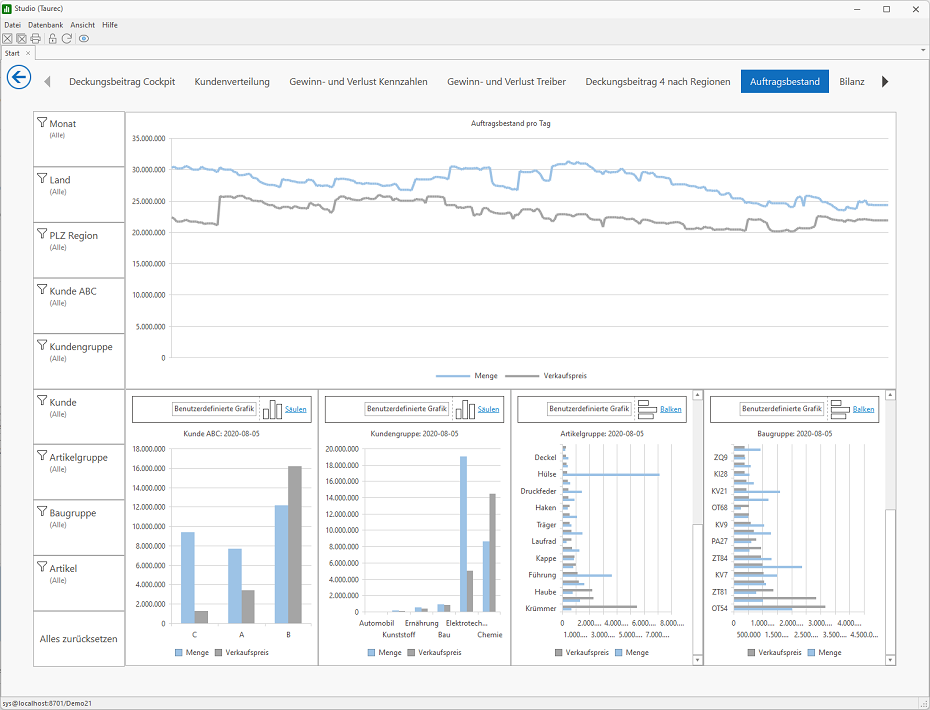
ManagementManagement requires a reliable basis for decisions. Ideally, managers obtain a timely overview themselves without the lengthy detour through specialist departments. Only in this way can they react quickly to day-to-day changes.
Taurec makes it straightforward to implement automated reporting and threshold monitoring. Key decision-support features include:
- Real-time analysis.
- Clear, focused dashboards.
- Cash flow analysis.
- Secure, location-independent access to data.

 Accounting
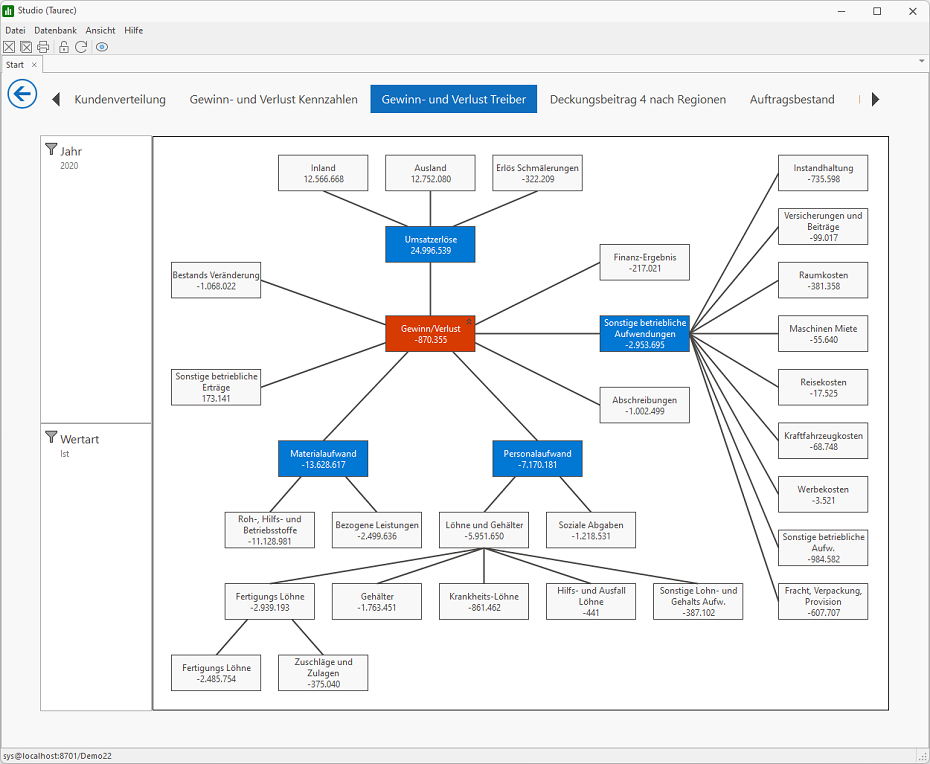
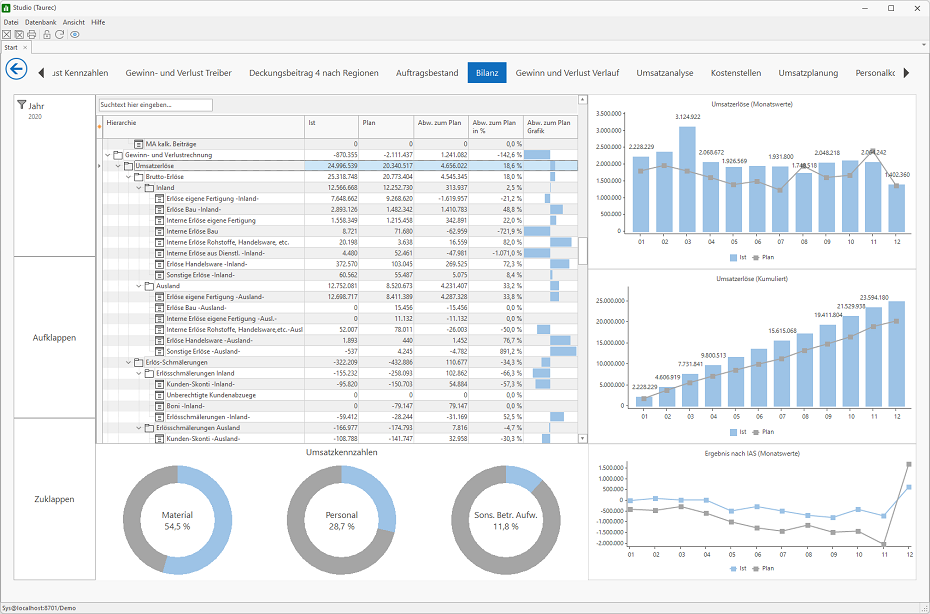
AccountingAccounting consolidates a company’s figures for internal stakeholders, owners, or banks. Different reporting perspectives, such as cost-of-sales or total-cost methods, require flexible hierarchies that can be represented by Taurec’s tree structures. Any number of trees with weightings can be defined and applied to the dataset without repeatedly creating new views. This is important for:
- Balance sheets and profit & loss statements (e.g., local GAAP, IAS, or country-specific rules).
- Consolidations.
- Profit and loss driver analysis.
- Versioning of chart of accounts.
- Currency conversions.
- Receivables, payables, and fixed-asset reports.
- Business unit analyses.

 Controlling
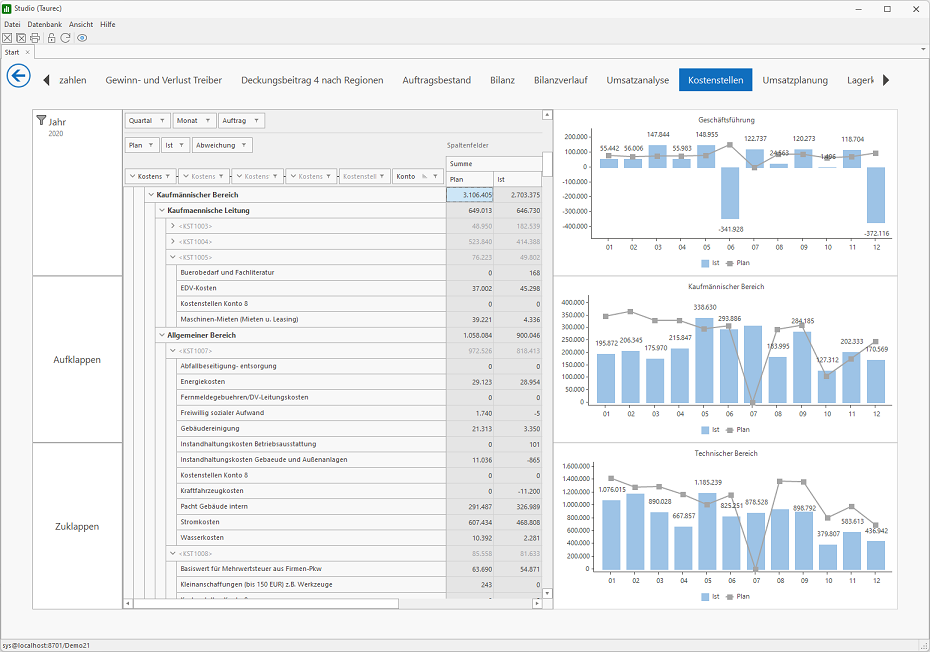
ControllingControlling covers planning, coordination, and monitoring within a company. This requires detailed reporting and complex analyses. Enriched with common key performance indicators, such analyses keep an eye on profitability.
It must be possible to move between arbitrary aggregation levels and to change perspectives via drill-down. The multidimensional data model makes this straightforward. Typical controlling requirements include:
- Actual vs. budget vs. plan comparisons and trend analysis.
- Planning and trend calculations.
- Scenario simulations.
- Variance analysis.
- Standard reports.
- Ad-hoc analyses.

 Sales
Sales
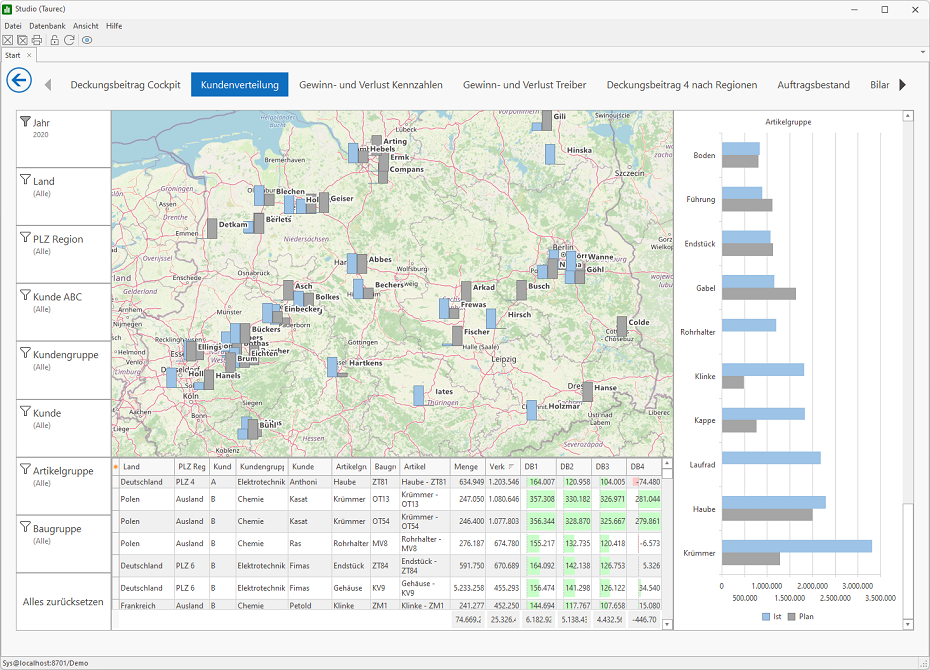
SalesSales aims to identify opportunities and risks early and to take appropriate action.
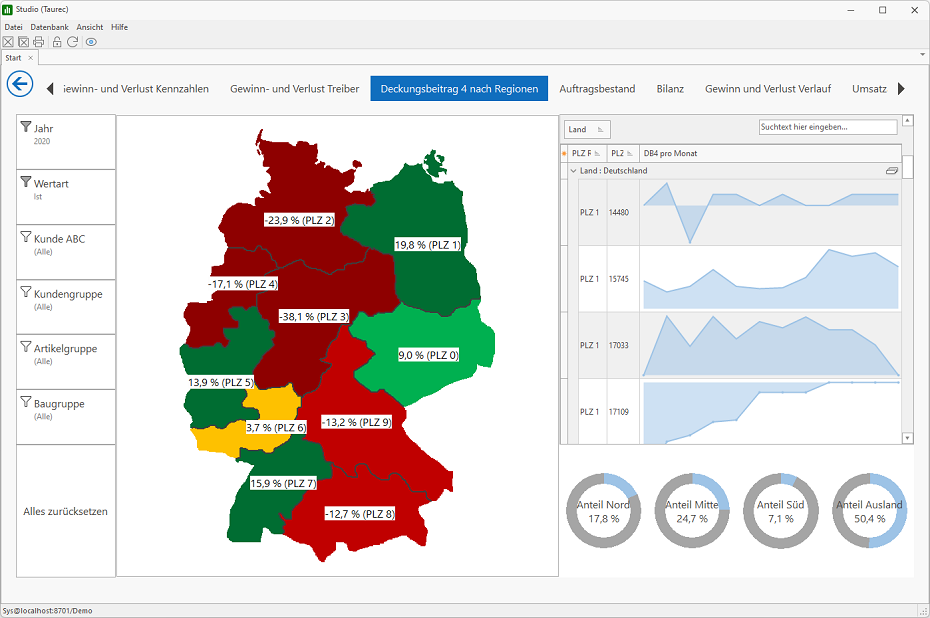
With Taurec, comparisons and rankings can be created at any level following a do‑it‑yourself principle, so hidden trends become visible quickly and market success can be improved. The following instruments support this:
- Customer or product rankings.
- Contribution-margin analyses.
- Time-based comparisons.
- Use of geodata.

 Planning
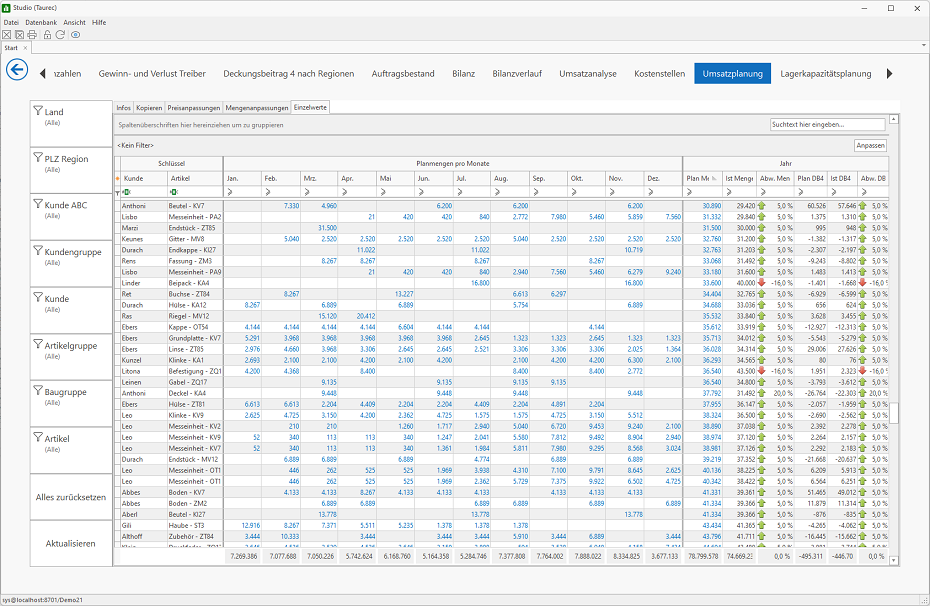
PlanningPurposeful steering of the business requires realistic planning. Planning approaches vary by business model, so the system must be able to represent different methods and requirements quickly, for example:
- Carrying forward actuals as a template for planning in the following year.
- Rule-based adjustments to apply percentage changes across entire data segments (e.g., regions, customers, or products).
- Recording adjustments as measures to keep plan changes and their effects traceable.
- Mixing actual and plan data during the year to produce trends and targets.
- Manual adjustment of values based on expert judgement.
- Top-down planning for group-level decisions.
- Rule sets to calculate certain accounts differently.

 Special Requirements
Special RequirementsSpecial requirements can also be realized, for example:
- Sales optimization and route planning.
- Reading and analyzing machine data.
- Processing and preparing Excel® spreadsheets for analysis.
- Screening against sanction lists.